
Organic Structures, Research, Optimization and Discovery in Biotechnology
Exploring Molecular Structures and Advancing Scientific Discovery
Scientific discovery depends on the ability to understand molecular complexity, investigate biological interactions, and develop innovative approaches to research. The combination of organic chemistry, structural investigation, and biotechnology provides valuable opportunities to explore new scientific perspectives and improve existing research methodologies.
Our approach focuses on the relationship between organic structures and biological systems, bringing together molecular research, chemical investigation, analytical methodologies, and technological development.
Through scientific exploration and continuous methodological improvement, we aim to contribute to a deeper understanding of molecular processes and the development of innovative research approaches in biotechnology.
From the investigation of organic compounds to the analysis of complex biological interactions, our scientific perspective is guided by precision, interdisciplinary knowledge, and a commitment to research excellence.
Understanding Organic Structures and Molecular Properties
Organic structures form the foundation of numerous chemical and biological processes. Their composition, molecular arrangement, and functional characteristics influence how compounds behave under different experimental conditions.
Understanding these properties requires a combination of chemical knowledge, structural analysis, and experimental investigation.
Our scientific interests include several important aspects of molecular chemistry:
Investigation of molecular structures and chemical composition.
Identification and characterization of functional groups.
Analysis of molecular interactions and chemical properties.
Exploration of organic reaction mechanisms.
Evaluation of structure–activity relationships.
Study of molecular transformations and reaction pathways.
These areas provide a foundation for exploring the relationship between chemical structure and biological function.
Research and Innovation in Biotechnology
Biotechnology is a multidisciplinary scientific field that integrates biological knowledge, chemical principles, and technological applications.
Research in this area contributes to the understanding of cellular mechanisms, biochemical pathways, microbial systems, and molecular interactions.
Modern biotechnology increasingly relies on advanced experimental approaches and interdisciplinary research to investigate complex biological questions.
Our research-oriented perspective encompasses:
Molecular biology and genetic investigation.
Biochemistry and cellular processes.
Microbiology and microbial biotechnology.
Protein structure and biomolecular interactions.
Molecular identification and characterization.
Biological process investigation.
Development of experimental research methodologies.
The integration of these disciplines supports a comprehensive approach to scientific investigation and technological innovation.
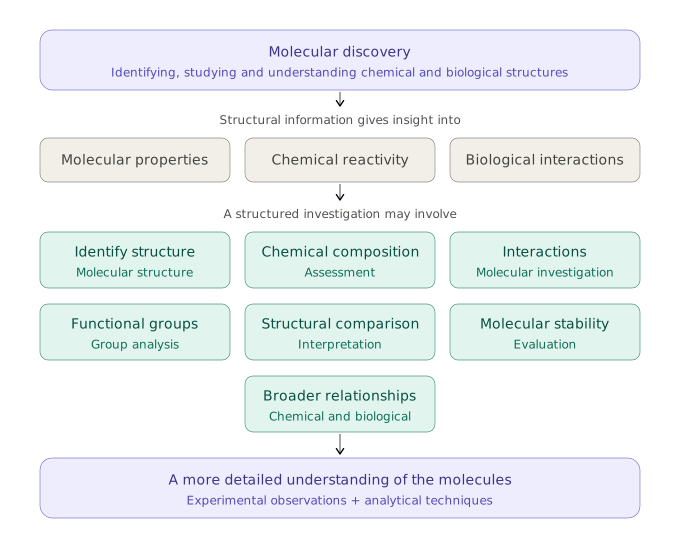
Molecular Discovery and Structural Investigation
Research Optimization and Experimental Development
Reliable scientific research requires carefully designed experiments and controlled methodologies.
Optimization is an essential component of the research process because it allows investigators to evaluate experimental conditions, identify potential limitations, and improve methodological performance.
Our approach to research optimization considers several complementary activities:
Experimental Design
Establishing appropriate research objectives, selecting relevant variables, and defining suitable experimental procedures.
Parameter Evaluation
Investigating the influence of reaction conditions, experimental settings, and analytical parameters on research outcomes.
Methodological Refinement
Reviewing existing procedures and identifying opportunities to improve experimental consistency.
Data Analysis
Interpreting experimental observations through appropriate analytical and statistical approaches.
Reproducibility Assessment
Evaluating the reliability of experimental procedures and documenting methodological variations.
This structured process contributes to more consistent research practices and supports the development of improved scientific methodologies.
Organic Chemistry and Synthetic Research
Organic chemistry provides essential knowledge for understanding the formation, modification, and transformation of carbon-based compounds.
Synthetic research involves investigating chemical reactions and developing appropriate pathways for preparing organic molecules with specific structural characteristics.
Important research topics include:
Organic reaction mechanisms.
Chemical synthesis strategies.
Reaction selectivity and efficiency.
Functional group transformations.
Molecular modification.
Catalytic reaction systems.
Chemical reaction optimization.
Purification and compound characterization.
A detailed understanding of these subjects can support research involving molecular design, chemical innovation, and the investigation of compounds relevant to biotechnology.
Analytical Chemistry and Advanced Characterization
Analytical chemistry plays a central role in scientific research by providing methods for identifying, separating, and characterizing chemical and biological substances.
The selection of an analytical technique depends on the nature of the sample, the research objective, and the information required.
Different analytical approaches can contribute to molecular and chemical investigations, including:
Chromatographic Techniques
Gas chromatography and high-performance liquid chromatography are used to separate and investigate complex mixtures. learn more
Mass Spectrometry
Mass spectrometry provides information about molecular masses, fragmentation patterns, and compound identification.
Spectroscopic Methods
Infrared spectroscopy and nuclear magnetic resonance spectroscopy provide valuable structural information about organic molecules.learn more

Quantitative Analysis
Appropriate analytical procedures help determine compound concentrations and evaluate variations between samples.
Data Interpretation
Analytical results must be carefully examined to establish meaningful relationships between experimental observations and molecular characteristics.
Molecular Interactions and Biological Systems
Understanding how molecules interact with biological systems is an important aspect of modern biotechnology.
Chemical structures can influence molecular recognition, biochemical reactions, and interactions between biological components.
Investigating these relationships requires knowledge of molecular properties and biological mechanisms.
Research topics in this area may include:
Protein–ligand interactions.learn more
Enzyme activity and biochemical mechanisms.
Molecular recognition processes.
Cellular signaling pathways.
Biomolecular structure and function.
Chemical interactions in biological environments.
Molecular stability and biological compatibility.
These investigations contribute to a better understanding of the mechanisms connecting chemical structures with biological functions.


Microbial Biotechnology and Biological Processes
Microbial biotechnology explores the use and investigation of microorganisms and their biological activities in scientific and technological applications.
Microorganisms represent complex biological systems with important metabolic and biochemical characteristics.
Their investigation requires an understanding of microbial physiology, molecular biology, and environmental factors affecting biological processes.
Relevant research areas include:
Microbial growth and metabolic activity.
Microbial diversity and characterization.
Enzymatic processes and biological transformations.
Microbial interactions with different environments.
Fermentation principles and process development.
Evaluation of biological process parameters.
Microbial biotechnology research methodologies.
These areas offer valuable opportunities for investigating biological systems and understanding their potential applications.
Technology and Innovation in Biotechnology
Technological progress continues to transform the way researchers investigate chemical and biological systems.
Advances in analytical instrumentation, molecular technologies, computational tools, and experimental automation are creating new opportunities for scientific development.
Emerging research approaches include:
Computational molecular modeling.
Structure-based molecular investigation.
Bioinformatics and biological data analysis.
Advanced analytical instrumentation.
Molecular simulation and visualization.
Automated experimental workflows.
Integrated chemical and biological research.
Combining technological innovation with experimental expertise can help address increasingly complex scientific questions.

From Molecular Research to Scientific Development
Scientific development involves transforming research questions into structured investigations and progressively refining experimental approaches.
This process requires coordination between molecular investigation, experimental design, analytical characterization, and data interpretation.
Our development-oriented framework follows five main stages:
1. Research Exploration
Identifying scientific questions and examining existing knowledge to establish relevant research directions.
2. Structural Investigation
Studying molecular composition, chemical properties, and potential interactions through appropriate experimental approaches.
3. Experimental Implementation
Selecting suitable methodologies and conducting structured scientific investigations.
4. Optimization and Validation
Evaluating experimental conditions, analyzing results, and refining research procedures.
5. Knowledge Development
Integrating findings into broader scientific perspectives and identifying opportunities for further investigation.
This framework emphasizes the importance of continuous improvement throughout the research process.

Future Perspectives in Molecular and Biotechnological Research
The future of biotechnology will continue to be influenced by developments in molecular sciences, organic chemistry, analytical technologies, and computational investigation.
Increasing interest in molecular structure analysis, biological interactions, and optimized experimental systems is creating new directions for scientific exploration.
Research into advanced analytical methodologies, molecular characterization, microbial systems, and computational approaches will remain important for understanding complex chemical and biological processes.
Continuous scientific development requires curiosity, methodological precision, and the ability to integrate knowledge from different research fields.